Since its commissioning in 2022, the Terminal Industriel Polyvalent de San Pedro (TIPSP) has rapidly emerged as a strategic bulk export and import hub in West Africa. Driven by mineral exports and industrial bulk imports, TIPSP has reinforced its role in regional trade, handling approximately 3.3mt (million [metric] tonnes) of cargo in 2025, within just four years of operation.
TIPSP was developed to accommodate Panamax-sized vessels directly at berth, featuring a 270-metre quay with a 14-metre vessel draft and 600,000 tonnes of cargo storage capacity. The terminal is now well recognized for its operational excellence, offering high handling rates for both import and export vessels, at par with international standards and among the best in West African ports. This performance has been recognized by the Association de Gestion des Ports de l’Afrique de l’Ouest et du Centre (AGPAOC), which conferred special awards to TIPSP during its annual programs held in Conakry, Guinea (2024) and Pointe-Noire, Republic of Congo (2025). These awards acknowledged TIPSP’s operational excellence and its contribution to the development of regional economies.
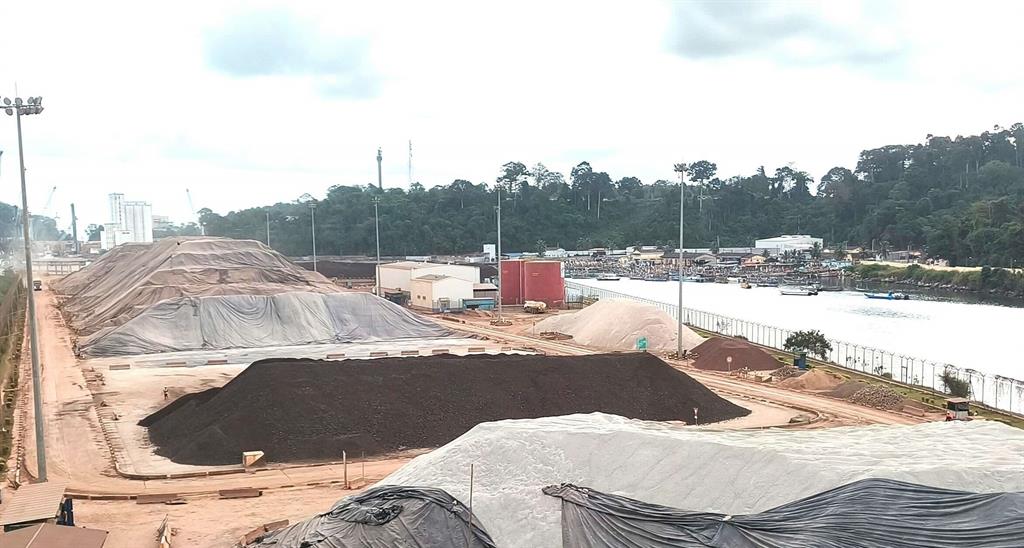
TIPSP has continued to diversify its commodity portfolio, introducing Lithium Spodumene exports alongside established mineral commodities such as Nickel, Manganese, and Iron Ore. On the import side, bulk commodities supporting regional cement industries — such as clinker, gypsum, limestone, and slag — have remained strong. This growth has been driven by increasing mining exports due to reduced logistics costs and improved handling efficiency, as well as rising demand for industrial bulk imports.
To leverage current and future growth potential and continue supporting its customers with best port infrastructure, TIPSP has ambitious expansion plan to double its capacity from 6mtpa (million metric tonnes per annum) to 12mtpa. The expansion will include the construction of a second quay capable of accommodating Panamax vessels, as well as an increase in cargo storage capacity from 0.6mt to 1.6mt for multi-commodity operations. TIPSP also offers customized storage solutions for commodities such as Lithium Spodumene, Fertilizer, and Clinker.
To improve fertilizer handling, the terminal is developing integrated storage and packaging facilities connected directly from ship to warehouse via conveyor systems, which will significantly reduce overall logistics costs and minimize handling losses for fertilizer importers. Additionally, to support nearby cement plants with higher discharge rates while improving environmental performance and reducing carbon footprint, TIPSP plans to install direct conveyor systems connecting the berth to cement plant storage facilities in the near future.
“2025 has built on the momentum of our prior growth phases. We continue to deliver throughput increases while investing in infrastructure, operational performance, and service reliability — all key factors in attracting exporters and importers across West Africa.” – Director General, TIPSP.
----------
Socioeconomic impact of Arise Ports & Logistics in Côte d'lvoire (Source: QBIS Report)
Upgrading bulk port infrastructure at San Pedro
- Côte d'Ivoire's export economy remains highly concentrated in agricultural commodities, limiting resilience to price volatility and external shocks.
- While the country has significant mineral and industrial potential, the ability to scale low-value bulk exports has historically been constrained by port capacity, handling efficiency, and logistics costs.
- The Terminal Industriel Polyvalent de San Pedro (TIPSP) represents a structural upgrade to Côte d'lvoire's bulk logistics system. By providing deep-draft access, mechanised handling, buffer storage, and dedicated industrial berths, TIPSP enables larger vessels, faster turnaround times, and more reliable operations compared to legacy multipurpose infrastructure.
Enabled economic impacts
A study commissioned by A P. Moller Capital and carried out by QBIS assessed the socioeconomic impacts enabled by TIPSP across export, import, and regional transit flows;
- Nickel ore: Exports existed prior to TIPSP; the port's contribution is incremental. Based on an estimated 12% reduction in transport and logistics costs and established trade elasticities, TIPSP is estimated to enable around 8% of total nickel-related impacts, equivalent to approximately 2,000 jobs and USD 11 million in GDP by 2030.
- Manganese ore: Prior to TIPSP, exports were physically constrained by port capacity. TIPSP enables scale-up rather than displacement. By 2030, manganese exports facilitated by TIPSP are estimated to support approximately 47,100 jobs and USD 254 million in GDP, representing the full socioeconomic impact of this export flow.
- Cementitious cargo: Lower import costs for clinker and related inputs improve purchasing power across the construction value chain. Under an illustrative pass-through scenario, TIPSP-enabled cost reductions correspond to approximately 5,300 jobs and USD 27 million in GDP by 2030.
- Fertilizer imports: TIPSP removes capacity constraints and reduces transport and logistics costs by nearly 20%, strengthening agricultural input supply. Under an illustrative full pass-through scenario, fertilizer-related cost reductions correspond to approximately 2,700 jobs and USD 14 million in GDP by 2030.
- Iron ore transit (Mali & Guinea): TIPSP enables San Pedro to function as a regional bulk export corridor. By 2030, iron ore exports facilitated via TIPSP are associated with approximately 22,700 mining jobs, USD 79 million in GDP, and USD 251 million in export revenues in Mall and Guinea. While production value accrues outside Côte d'lvoire, transit volumes generate domestic value added through port handling, logistics services, and coordination-positioning San Pedro as a regional gateway.
Strategic significance
- Taken together, these impacts demonstrate that TIPSP's contribution extends beyond port operations. By lowering logistics costs, improving reliability, and removing capacity constraints, the terminal strengthens upstream mining activity, supports downstream industrial users, enhances agricultural productivity, and increases household purchasing power through lower input prices.
- From a broader perspective, TIPSP illustrates how targeted logistics infrastructure can unlock economic value well beyond the port perimeter. Rather than relying on subsidies or price support, the terminal improves competitiveness through lower trade costs, greater reliability, and scale. This positions Côte d'lvoire to diversify its export base, strengthen industrial linkages, and build resilience to external shocks -- while simultaneously supporting regional economic integration across West Africa.
For more information, visit
https://www.arisepl.com/location/ivory-coast/