In ports where dry bulk arrives and departs by rail and barge, quay space is the scarcest resource. This is where Ardelt Kranbau GmbH of Eberswalde, Germany, sees the decisive advantage of its rail-mounted double-jib slewing cranes on high gantries (portals).
A high-gantry crane keeps the area beneath the portal free for traffic — railway tracks, port vehicles, forklifts and other small equipment can pass directly underneath the working crane. Mobile harbour cranes, by contrast, occupy exactly this space: they must either be positioned behind the tracks or they block them, forcing internal port traffic onto detours. For terminals with limited ground area in particular, this makes the high-gantry concept highly attractive — and Ardelt notes that even mobile cranes fitted with a high portal are drawing growing interest for the same reason.
Double level luffing crane with rubber mobile travelling gear.
Every Ardelt gantry is tailored to the individual customer. Some operators run one railway track beneath the portal, others two or three. In one project, Ardelt built a gantry of 87 metres for a slewing crane — and the customer makes full use of the area underneath it.
Ardelt specializes in electrically driven double-jib level-luffing cranes, based on the original Ardelt double-jib principle. The system keeps the hook height constant as the outreach changes, produces short, horizontal load paths with minimal load sway, and recovers energy during luffing — resulting in high handling rates at low operating costs. The current portfolio includes:
- Tukan, Kondor: the versatile multipurpose double-jib crane for bulk, general cargo, containers and heavy lifts;
- Tukan K (Kangaroo): the bulk specialist with an integrated hopper in the gantry, eliminating the slewing motion to the shore hopper, raising throughput and minimizing dust emissions; and
- Feeder Server and RMG cranes: alongside its slewing cranes, Ardelt also supplies compact ship-to-shore (STS) cranes, known at Ardelt as the ‘Feeder Server’, as well as rail-mounted gantry cranes, both of which can be used for unloading bulk cargo as well as containers;
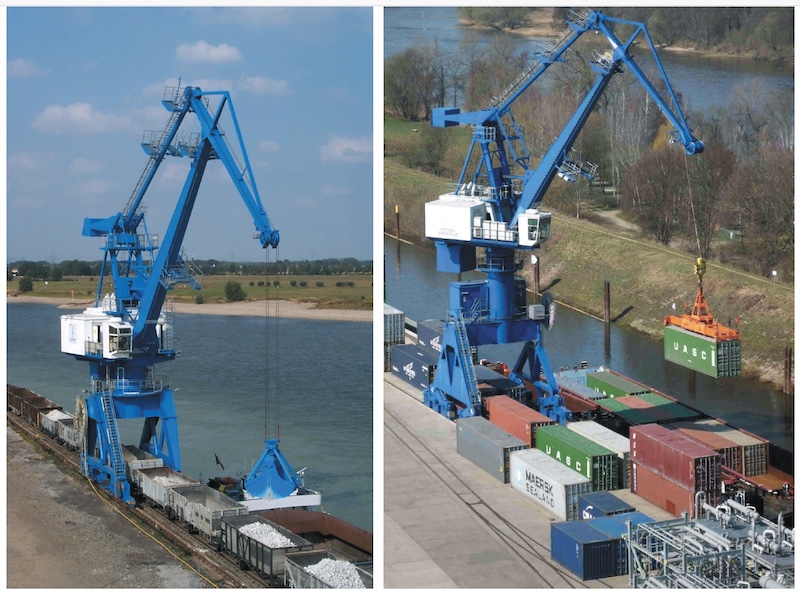
Ardelt cranes are true all-rounders. In grab operation they handle the full range of dry bulk — coal, ores, grain, fertilizers, aggregates and more. Fitted with a magnet system they handle scrap and steel products; with a spreader they handle containers; and with the hook they handle general cargo and project loads. Whether an inland port or a seaport, with moderate or very high throughput, and whether the terminal concentrates purely on bulk, purely on containers, or on combined handling, Ardelt configures the crane to the port’s needs. In reality, most customers order one crane for many duties: current customers in Germany and Poland have specified multipurpose cranes with 50m outreach, combining grab operation for bulk, a magnet installation for metal handling, container handling and project cargo.
Ardelt’s answer to the competitive pressure from mobile harbour cranes is a combination of the double-jib principle’s inherent efficiency, minimal operating costs, and a robust, long-life steel structure designed for continuous duty. And while the industry debates decarbonization today, Ardelt cranes have been green for years: they run fully electric — with energy recovery during luffing and lowering, no diesel engine and no local emissions on the quay. This keeps energy consumption low and supports ports’ climate targets by design. For an operator that depends on trouble-free, around-the-clock operation, the company argues, a rail-mounted double-jib crane on a high gantry is one of the best investments a port can make — it works reliably for decades while leaving the quay beneath it open for rail and vehicle traffic.